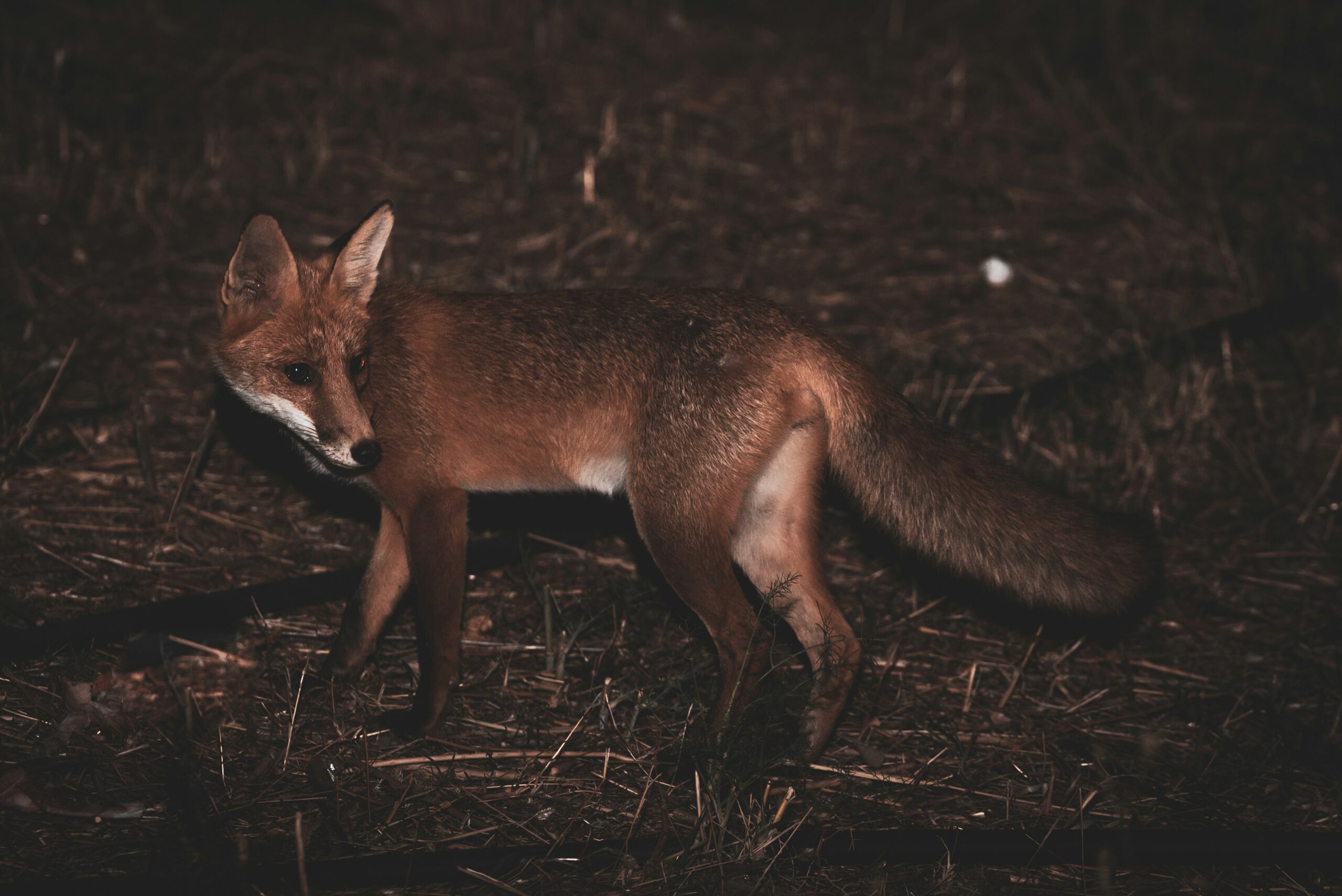
People are often surprised to see the same fox appearing in different parts of a neighbourhood within a single evening.
A fox may be spotted in one garden at dusk, crossing a nearby road later that night, and returning to a familiar route before dawn. This naturally raises the question: how far do foxes actually travel in one night?
The answer depends on where the fox lives, the availability of food, the time of year, and whether it is defending a territory or searching for new opportunities.
Understanding how far foxes travel helps explain many common urban sightings and why the same fox may appear in several locations over the course of a single night.
How Far Do Foxes Travel in One Night? (Quick Answer)
Urban foxes typically travel several kilometres during a single night while searching for food, checking territorial boundaries, and moving between resting areas. The exact distance varies depending on habitat, food availability, the breeding season, and whether the fox is an established adult or a young animal dispersing into a new area.
Why Do Foxes Travel So Much?
Foxes spend much of their active time moving.
Unlike animals that remain in one location, foxes regularly travel throughout their territory to access the resources they need.
A typical night may involve travelling between:
- feeding areas
- resting sites
- water sources
- territorial boundaries
- den locations
Rather than wandering randomly, these journeys usually follow familiar routes that the fox has learned over time.
How Far Does an Urban Fox Usually Travel?
Urban foxes generally travel shorter distances than rural foxes because food and shelter are often easier to find.
Within towns and cities, a fox may visit several gardens, parks, alleyways, and green spaces during a single night without leaving its established territory.
Many journeys involve moving steadily between known locations rather than covering long distances in a straight line.
The total distance travelled can still amount to several kilometres over the course of an evening as the fox patrols its home range and searches for food.
Why Do Some Foxes Travel Further Than Others?
Not every fox covers the same distance.
Several factors influence how much a fox travels during the night.
Food Availability
Where food is plentiful, foxes often travel less.
Gardens with reliable food sources, compost, fallen fruit, insects, or natural prey reduce the need to search over large areas.
Where food is scarce, foxes may spend much longer moving between feeding opportunities.
Territory Size
Foxes living in larger territories naturally have further to travel.
Territory size varies between rural and urban environments and depends largely on food availability and population density.
How big is a fox territory in the UK? explains how territory size influences the way foxes move around their home range.
Time of Year
Season also affects nightly travel.
During the breeding season, adults may travel further while:
- searching for mates
- defending territory
- checking scent markings
Later in spring, adults raising cubs often remain closer to the den while making repeated feeding trips.
Young foxes dispersing in autumn can travel much greater distances than established adults as they search for vacant territories.
Do Foxes Follow the Same Routes?
Usually, yes.
Foxes rarely move randomly through their territory.
Instead, they develop regular pathways connecting important locations.
These routes often follow:
- garden boundaries
- hedgerows
- alleyways
- railway embankments
- parks
- streams
Using familiar routes allows foxes to travel efficiently while reducing unnecessary risks.
Why do foxes follow the same route every night? explores how these predictable movement patterns develop within urban territories.
Can Foxes Travel Between Several Gardens?
Yes.
Many residential gardens form part of a much larger territory.
A fox visiting one garden may continue into several neighbouring gardens during the same evening.
From the fox’s perspective, fences rarely define territory.
Instead, gardens often function as connected feeding and travel areas linked by gaps, fences, walls, hedges, and other access points.
This is one reason neighbours frequently report seeing what is likely to be the same fox on the same night.
Do Foxes Return to the Same Places?
Foxes commonly revisit locations that have proved useful in the past.
These may include:
- feeding sites
- sheltered resting places
- reliable water sources
- quiet gardens
- regular travel routes
Returning to familiar locations allows foxes to move more efficiently and reduces the need to explore unfamiliar areas every night.
Do foxes remember places? explains how memory helps foxes navigate their territory and repeatedly locate important resources.
Do Foxes Leave Their Territory?
Usually, no.
Established adult foxes generally remain within a defined territory that provides the food, shelter, and resources they need.
Although they may travel several kilometres during a single night, most of this movement takes place within the boundaries of their home range rather than beyond it.
There are, however, some exceptions.
Young foxes often leave their birth territory during autumn as they search for an unoccupied area in which to establish their own territory. This process, known as dispersal, can involve travelling much greater distances than an adult fox would normally cover during its nightly routine.
Adult foxes may also venture beyond their usual boundaries occasionally if food becomes scarce, territories change, or during the breeding season when interactions with neighbouring foxes become more frequent.
For most urban foxes, however, leaving their territory is the exception rather than the rule. The majority of their nightly movements involve travelling repeatedly between familiar locations within an established home range.
Do Rural Foxes Travel Further?
Often, yes.
Rural foxes usually occupy larger territories where food sources are spread over greater distances.
They may travel further between hunting areas, den sites, and territorial boundaries than foxes living in towns and cities.
However, movement patterns still depend on habitat quality and food availability.
Some rural foxes may travel relatively little, while some urban foxes cover surprisingly large distances within complex built environments.
How Fast Can a Fox Travel?
Foxes are agile and efficient movers.
Most routine travel involves a relaxed walking pace or light trot.
They conserve energy by moving steadily between familiar locations.
When necessary, foxes can:
- sprint quickly to escape danger
- jump obstacles
- climb suitable structures
- change direction rapidly
Most nightly journeys involve steady, purposeful movement rather than continuous running.
Why Do Foxes Seem to Appear Everywhere?
People often assume there are many different foxes moving through an area.
In reality, repeated sightings sometimes involve the same individual.
A fox may travel through several streets or gardens over the course of a night while carrying out its normal routine.
Because these journeys often follow familiar routes, sightings can appear surprisingly predictable.
This does not necessarily indicate that fox numbers are unusually high.
Instead, it reflects how efficiently foxes move throughout their territory.
Are Long Nightly Journeys a Cause for Concern?
Usually not.
Travelling is a normal part of fox behaviour.
Healthy foxes regularly move around their territory while:
- searching for food
- checking scent markings
- communicating with neighbouring foxes
- visiting resting areas
- responding to seasonal changes
Longer journeys are often simply a reflection of changing environmental conditions rather than a sign that something is wrong.
Understanding how far foxes travel can help explain why the same fox may appear repeatedly in different parts of a neighbourhood without actually living in any one garden.
Common Questions
How far can a fox travel in one night?
Urban foxes often travel several kilometres while moving between feeding areas, resting sites, and territorial boundaries.
Do foxes stay in one area?
Established adult foxes usually remain within a defined territory, although they move extensively within it.
Why does the same fox appear in different streets?
Foxes often use regular travel routes that pass through multiple gardens and neighbourhoods during a single night.
Do foxes leave their territory every night?
Most established adults remain within their territory, although young dispersing foxes may travel much greater distances.
Are urban foxes always close to their den?
No. Foxes often spend much of the night travelling between different parts of their territory before returning to a resting site.
Can two neighbours be seeing the same fox?
Yes. A single fox may pass through several neighbouring gardens during its nightly movements.
Key Takeaways
- Urban foxes typically travel several kilometres during a single night.
- Most nightly journeys involve moving between food sources, resting places, territorial boundaries, and water sources.
- Urban foxes usually travel shorter distances than rural foxes because resources are more concentrated.
- Foxes commonly follow the same routes through their territory rather than wandering randomly.
- The distance travelled varies according to food availability, the breeding season, territory size, and whether the fox is an established adult or a dispersing juvenile.
- Seeing the same fox in different streets or neighbouring gardens is often a normal result of its nightly movements.
- Regular travel is a natural part of healthy fox behaviour and is rarely a cause for concern.
Sources and Further Guidance
- The Mammal Society – Overview of red fox ecology, territorial behaviour, movement patterns, and adaptation to urban environments.
- The Wildlife Trusts – Species guide covering habitat use, feeding behaviour, territories, and how foxes move through urban and rural landscapes.
- RSPCA – Guidance on understanding urban fox behaviour and living responsibly alongside foxes in residential areas.
- MammalWeb – Information on fox ecology, behaviour, territoriality, dispersal, and movement.
- Wildlife Online – Detailed reference covering fox territories, ranging behaviour, dispersal, and daily movement patterns.
- Natural England – General guidance on understanding and coexisting with British wildlife in urban and rural environments.
For more guidance on living alongside foxes, visit our fox guidance hub, where you can explore behaviour, prevention strategies, and UK wildlife law.
0 responses to “How Far Do Foxes Travel in One Night?”