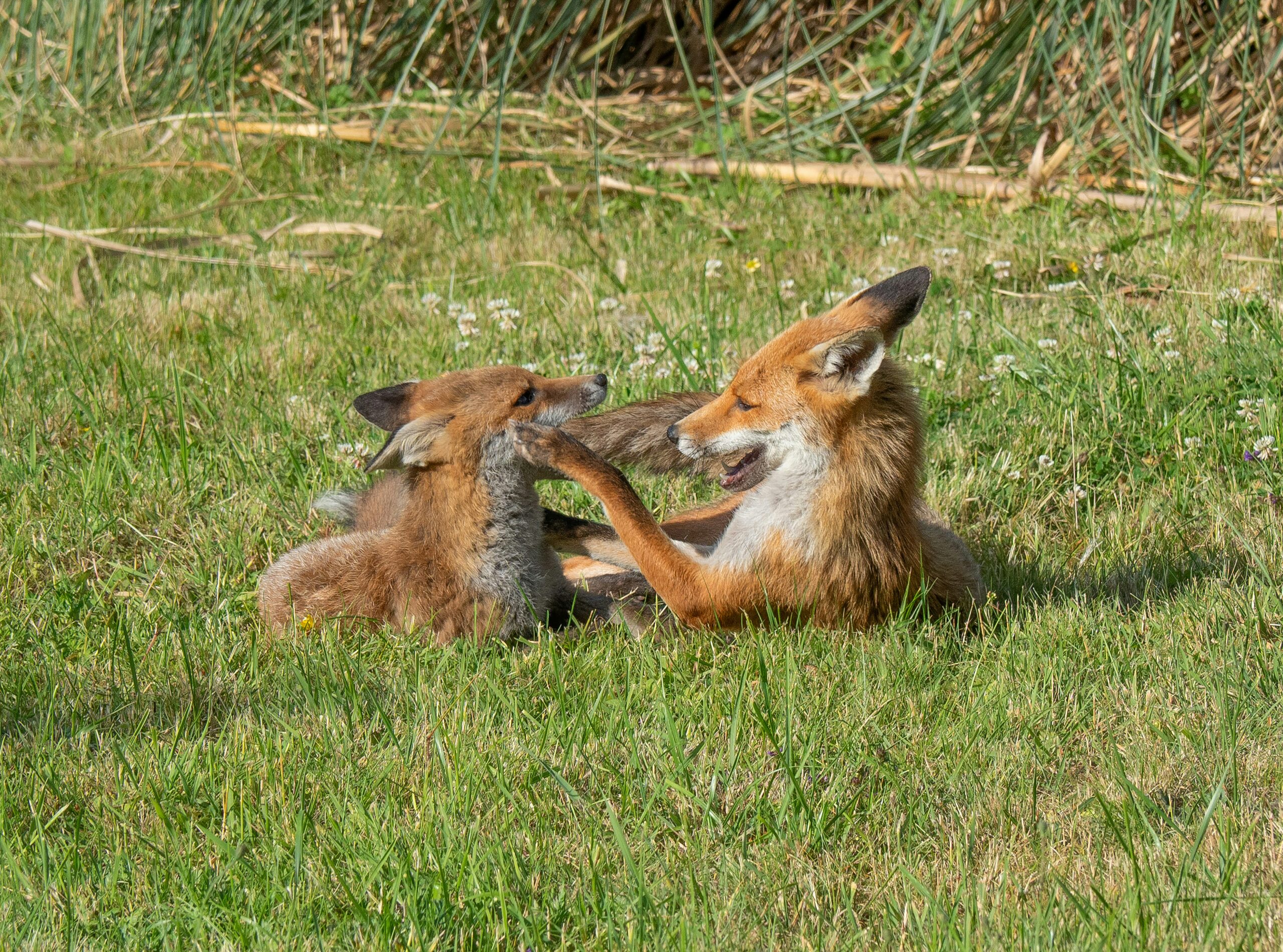
Foxes are often thought of as solitary animals, but they communicate with one another in a variety of sophisticated ways.
Whether defending a territory, locating family members, attracting a mate, or avoiding conflict, foxes rely on a combination of sounds, scent, body language, and behaviour to share information.
Much of this communication happens without direct contact. A fox may learn that another fox has recently passed through an area simply by detecting scent markings, while brief vocalisations can help maintain distance between neighbouring foxes without the need for physical confrontation.
Understanding how foxes communicate helps explain many of the behaviours people observe in towns, cities, and the countryside.
How Do Foxes Communicate With Each Other? (Quick Answer)
Foxes communicate using vocalisations, scent marking, body language, facial expressions, and behaviour. Different methods are used depending on the situation, helping foxes defend territories, find mates, raise cubs, avoid conflict, and share information with other foxes.
Why Is Communication Important for Foxes?
Communication allows foxes to survive while reducing unnecessary risks.
Instead of fighting over territory or food, foxes can often resolve potential conflicts by signalling their presence.
Communication also helps family groups remain organised during the breeding season and enables foxes to respond appropriately to changes within their environment.
Each method of communication provides different information depending on the circumstances.
Vocal Communication
Foxes are capable of producing a surprisingly wide range of sounds.
Different vocalisations serve different purposes and are often influenced by the time of year, the fox’s age, and the situation.
Effective vocal communication depends not only on producing calls but also on detecting them. How good is a fox’s hearing? explores how foxes use their remarkable hearing to interpret sounds across their territory.
Common fox vocalisations include:
- barking
- screaming
- short yelps
- whines
- growls
- contact calls between adults and cubs
Most vocal communication occurs during the breeding season or when foxes need to communicate across greater distances.
Barking
Fox barking is often heard at night and usually serves as a territorial signal.
A bark can:
- announce a fox’s presence
- warn neighbouring foxes
- help maintain spacing between territories
- attract attention during the breeding season
Unlike domestic dogs, foxes rarely bark continuously.
Why do foxes bark at night? explains the different reasons foxes bark and why this behaviour is especially noticeable after dark.
Screaming
Fox screams are among the most recognisable wildlife sounds in the UK.
These loud calls are most common during the breeding season and are associated with mating behaviour, territorial disputes, and communication between adults.
Although the sound can seem alarming, it is usually a normal part of fox behaviour.
Why do foxes scream at night? explores why foxes produce these distinctive calls and when they are most commonly heard.
Scent Marking
Not all fox communication involves sound.
In fact, scent marking is one of the most important ways foxes communicate.
Foxes leave scent in many locations throughout their territory using urine, faeces, and specialised scent glands.
These scent marks provide valuable information to other foxes.
A fox may learn:
- another fox’s presence
- territorial boundaries
- breeding status
- how recently another fox visited the area
Unlike vocal communication, scent markings can continue providing information long after the fox has moved on.
Body Language
Foxes also communicate through posture and movement.
Many encounters between foxes involve little or no vocalisation.
Instead, body language helps each fox judge the intentions of the other before deciding how to respond.
Common signals include:
- standing tall
- lowering the body
- turning sideways
- slow approach
- retreating calmly
These visual signals help reduce unnecessary conflict by allowing foxes to assess one another before direct interaction occurs.
Tail Movements
Although less expressive than domestic dogs, foxes also use their tails when communicating.
Tail position can reflect:
- confidence
- caution
- relaxation
- readiness to move
The tail also makes the fox’s body movements easier for nearby foxes to interpret, particularly in low-light conditions.
Rather than conveying complex emotions, tail movements usually reinforce other aspects of the fox’s body language.
Facial Expressions
Foxes use subtle facial cues alongside posture and movement.
Other foxes may observe:
- ear position
- eye contact
- head position
- mouth shape
For example, direct eye contact may indicate alertness, while relaxed facial features often suggest there is no immediate threat.
These expressions are usually combined with scent and body language rather than used on their own.
Communication Between Family Members
Although adult foxes spend much of their time foraging alone, communication within family groups remains important.
Parents communicate with cubs using:
- quiet vocalisations
- body language
- scent
- repeated routines
As cubs grow, they gradually learn to recognise these signals and respond appropriately.
This communication helps young foxes remain close to the family while developing the skills needed for independent life.
How Foxes Avoid Conflict
Communication is often about preventing fights rather than starting them.
Most foxes prefer to avoid unnecessary confrontation because injuries can reduce their chances of survival.
Before entering another fox’s territory, a fox may first detect scent markings or hear vocalisations indicating another animal is nearby.
If both foxes become aware of one another, body language and brief vocal signals often allow each animal to assess the situation without fighting.
Actual physical conflict is relatively uncommon compared with the amount of communication that occurs beforehand.
Do Urban Foxes Communicate Differently?
The methods remain largely the same.
However, urban environments influence how communication is used.
In towns and cities:
- territories are often smaller
- foxes encounter one another more frequently
- human activity creates additional noise
- gardens and fences influence movement
As a result, urban foxes often rely heavily on scent marking and familiar routines while adjusting their vocal behaviour to busy environments.
Can People Observe Fox Communication?
Yes, although much of it is subtle.
People are most likely to notice:
- barking at night
- screaming during the breeding season
- scent marking around gardens
- foxes approaching cautiously before changing direction
- brief interactions between neighbouring foxes
Many of these behaviours are part of normal communication rather than signs of aggression.
Understanding these signals helps explain why foxes often appear calm and predictable despite living in busy urban environments.
Why Understanding Fox Communication Matters
Fox communication is an essential part of their daily lives.
Rather than relying on a single method, foxes combine sounds, scent, body language, and behaviour to share information with one another.
These signals help them defend territories, locate mates, raise cubs, avoid conflict, and move safely through their environment.
For people who regularly see foxes in gardens or neighbourhoods, recognising these behaviours provides a better understanding of how foxes interact with one another and why many of their actions are simply part of normal, healthy urban fox behaviour.
Common Questions
Do foxes communicate with each other?
Yes. Foxes communicate using vocalisations, scent marking, body language, facial expressions, and behaviour. Different methods are used depending on the situation, such as defending territory, finding mates, or raising cubs.
Why do foxes bark and scream?
Foxes bark to announce their presence, maintain territories, and communicate with nearby foxes. Screaming is most common during the breeding season and is often linked to mating behaviour or territorial interactions.
Do foxes use scent to communicate?
Yes. Scent marking is one of the most important forms of fox communication. Foxes leave scent marks to identify territories, advertise breeding status, and signal that an area has recently been visited.
Can foxes communicate without making noise?
Absolutely. Much of fox communication is silent. Body posture, tail position, facial expressions, and scent markings often allow foxes to exchange information without vocalising.
How do foxes communicate with their cubs?
Adult foxes use quiet vocalisations, body language, scent, and repeated behaviour to guide and protect their cubs. As cubs mature, they learn to recognise and respond to these signals.
Do urban foxes communicate differently from rural foxes?
The methods are the same, but urban foxes often communicate more frequently because territories are smaller and encounters with neighbouring foxes are more common. They also adapt their behaviour to the increased noise and activity of towns and cities.
Key Takeaways
- Foxes communicate using vocalisations, scent marking, body language, facial expressions, and behaviour.
- Different communication methods serve different purposes, including defending territory, attracting mates, raising cubs, and avoiding conflict.
- Scent marking allows foxes to exchange information even when they are not physically present.
- Barking and screaming are normal forms of communication and are especially common during the breeding season.
- Most communication between foxes is subtle and helps prevent unnecessary fights.
- Urban foxes use the same communication methods as rural foxes but adapt them to life alongside people.
- Understanding fox communication helps explain many of the behaviours commonly seen in gardens and neighbourhoods.
Sources and Further Guidance
- The Mammal Society – Overview of red fox ecology, behaviour, social organisation, and communication in the UK.
- The Wildlife Trusts – Species guide covering fox behaviour, vocalisations, breeding, habitat, and adaptation to urban environments.
- Wildlife Online – Comprehensive reference explaining fox communication, scent marking, territorial behaviour, and social interactions.
- MammalWeb – Information on fox ecology, movement, territoriality, and behavioural adaptations.
- RSPCA – Advice on understanding urban fox behaviour and interpreting common fox activities around homes and gardens.
- Natural England – General guidance on understanding and coexisting with native British wildlife.
For more guidance on living alongside foxes, visit our fox guidance hub, where you can explore behaviour, prevention strategies, and UK wildlife law.
0 responses to “How Do Foxes Communicate With Each Other?”